There are plenty of clothing wholesale markets across China. But where should you actually go to source? Even for the same categories, like womenswear, knitwear, and kidswear, different regions can vary a lot in styles, supply chains, and sourcing strengths.
In this guide, we’ll compare what different clothing wholesale markets are best for, so you can choose the right place based on your products and sourcing needs.
Guangdong vs. Zhejiang: Which is better for your clothing business?
Guangdong and Zhejiang are key clothing sourcing hubs in China’s Pearl River Delta and Yangtze River Delta manufacturing clusters, respectively.
Both have wholesale markets covering many clothing categories. We’ll first compare the same categories to see which region is better for what, then look at the clothing markets each region is especially known for.
Guangzhou vs. Hangzhou — womenswear
Guangzhou’s clothing markets are especially strong in fast fashion, with major hubs like Shisanhang (十三行) and the Shahe clothing market area (沙河商圈). On the whole, Guangzhou’s clothing supply chain is known for small orders and quick turnaround.
Hangzhou is especially strong in autumn and winter womenswear. Sijiqing (四季青) is one of its best-known wholesale market clusters. The city is also well known for silk apparel.
Dongguan vs. Jiaxing — knitwear
Dalang, a town in Dongguan, is generally more export-oriented, with a mature OEM/ODM supply chain for overseas orders.
Puyuan, a town in Jiaxing City, Zhejiang Province, is stronger in wool and cashmere sweaters.
Guangdong’s kidswear hubs vs. Zhili, Zhejiang
Kidswear sourcing in Guangdong is mainly concentrated in Guangzhou, Dongguan, and Foshan, where both adult and children’s wear are widely available.
Zhili in Huzhou, Zhejiang, is known as China’s kidswear capital and is especially strong in fashionable kidswear.
Other clothing specialties
Zhejiang
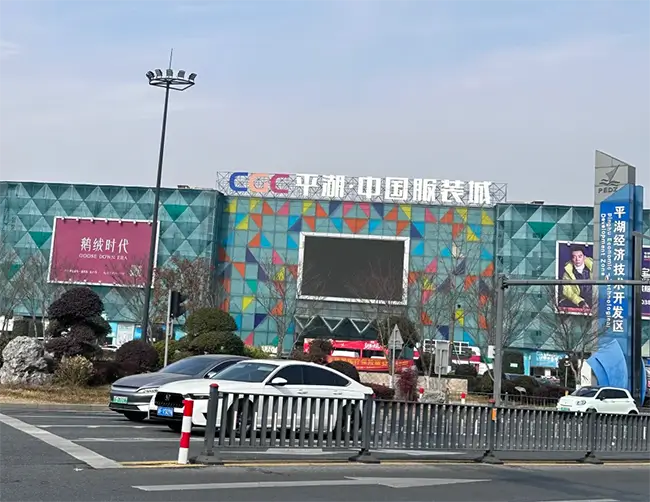
- Pinghu is worth considering if you source down jackets, with specialized markets such as CGC Pinghu China Garment City (CGC平湖·中国服装城).
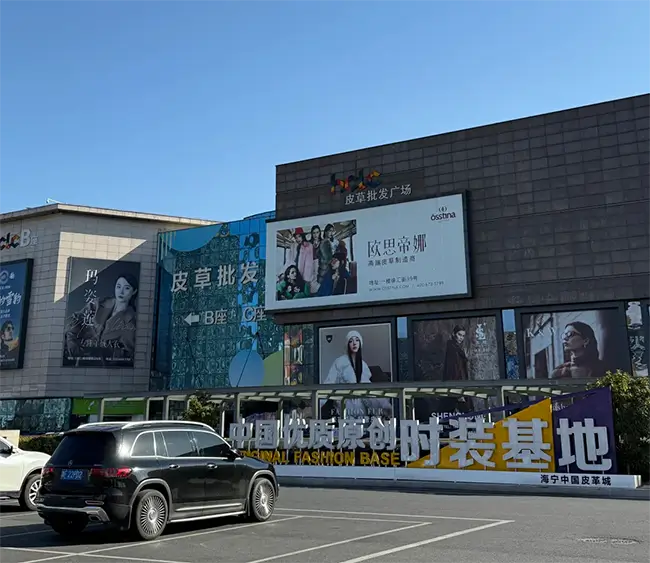
- Haining China Leather City (海宁中国皮革城) is best known for leather and fur apparel, its most traditional and core categories.
- Datang in Zhuji is widely known as China’s “International Hosiery Capital”.
- Yiwu — seamless underwear. Best for sports bras, seamless tank tops, and seamless shorts.
- Ningbo — business menswear and suits.
Guangdong
- Xintang, Guangzhou — China’s largest wholesale market for denim clothing, especially jeans.
- Guangzhou wedding street — the largest wholesale hub for wedding dresses and evening gowns in Guangdong.
Shishi, Fujian — Sportswear and casual menswear
Shishi is strong in casualwear, sportswear, school uniforms, custom jerseys, and other performance apparel. Its menswear supply chain is especially flexible, with fast turnaround for casual and business-casual styles.
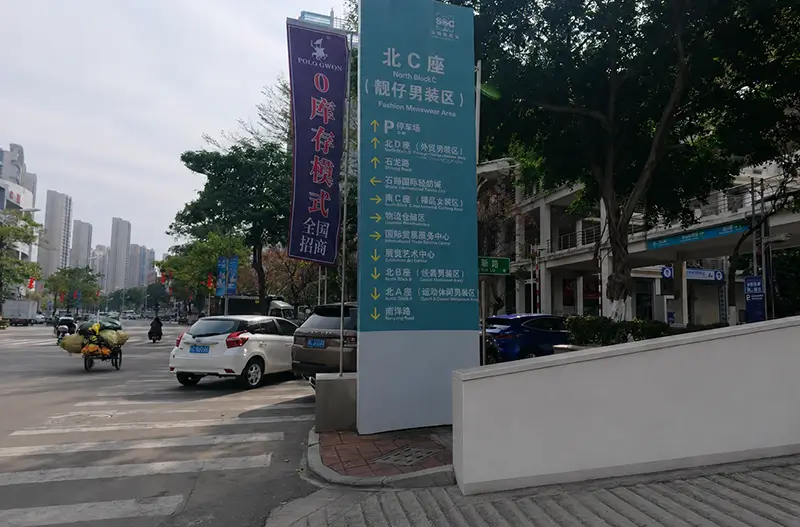
Shishi Clothing City (石狮服装城) is one of the main wholesale markets here. Its southern section mainly focuses on womenswear and kidswear, while the northern section focuses on menswear, with several buildings in each section.
- North D is particularly export-oriented, with buyers mainly coming from the Middle East, Africa, and Europe.
Suzhou Huqiu Bridal City
Huqiu Bridal City (虎丘婚纱城) is China’s largest wholesale market for wedding dresses, accounting for around 70%–80% of the domestic market. Its biggest advantages are the high concentration of suppliers and competitive prices. Overall, the quality is usually a bit lower than Guangzhou’s.
For wholesale wedding dresses from China, basic styles can start at just a few dozen dollars. More expensive designs are usually around $100 or slightly higher, depending on the fabric and design details, while mid- to high-end dresses typically cost several hundred dollars.
You may also find these guides useful:
Do you need a local sourcing agent?
If it’s your first time visiting clothing wholesale markets in China, or you’re looking to expand your product lines or improve your supplier base, working with an experienced local sourcing agent can make the process much easier.
A local agent can shortlist the right markets and factories based on your product needs, plan your visits, and help communicate specifications, customization details, and prices with suppliers. They can also follow up on garment production, quality inspection, and arrange shipping.
For new or small clothing businesses that don’t plan to visit China, sourcing online through platforms like Alibaba is another option. A local agent can help check garment quality, consolidate and arrange shipments as required.
Some buyers also use 1688, a wholesale platform designed for the Chinese domestic market, so it can be challenging for overseas buyers.
With JingWholesale, you can browse 1688 products and add what you want to your cart — from just $50 per SKU.
Here’s how JingWholesale works
- Create an account
- Add products to your cart and mix items freely
- We collect the goods from different suppliers
- We inspect quality, repack everything, and ship to your door