When paying suppliers on Alibaba, most buyers care about two things:
Is it safe? And am I paying more than I should?
This guide focuses on the real decisions you need to make before paying—rather than walking through every option and step already covered on Alibaba.
How does payment actually work on Alibaba?
Pay through Alibaba—your payment is held until you confirm receipt.
Paying through Alibaba means your order is covered by Trade Assurance—Alibaba’s buyer protection service, which involves two main types of fees.
1. Platform service fee (charged to suppliers)
Alibaba charges suppliers 2%–3% per transaction, with a cap of $100–$350. While this fee is officially paid by suppliers, in practice, most suppliers include it in product pricing — so buyers often end up paying for it.
2. Buyer-side payment processing fee
Buyers need to pay a payment processing fee, typically 2.99% or a fixed fee, depending on the method used.
This fee is collected by Alibaba but essentially goes to banks or payment providers—Alibaba typically does not add a significant markup.
For first-time buyers or when working with a new supplier, using Trade Assurance is generally worth the extra cost for the added security.
Explore more: Alibaba Trade Assurance: Top 5 Buyers’ Concerns Solved.
Pay suppliers directly—cheaper, but riskier.
For example, paying suppliers directly by T/T to their bank account, or using Western Union or MoneyGram.
These may seem cheaper (no 2.99% fee), but you lose all buyer protection. If something goes wrong—supplier disappears or sends defective or non-compliant products—you’re on your own.
What is the safest way to pay on Alibaba?
The safest way is to use Trade Assurance with a credit card or PayPal. This gives you double protection—Alibaba protection plus chargeback support from your bank or PayPal if something goes wrong.
Best for small orders, such as samples or test orders in the range of a few hundred to around $1,000.
Not suitable for large orders because:
- Credit card payments come with relatively high processing fees, making them less cost-effective.
- Many Chinese suppliers are reluctant to accept PayPal for large transactions due to high fees and increased chargeback risk.
What is the most cost-effective way to pay Alibaba suppliers?
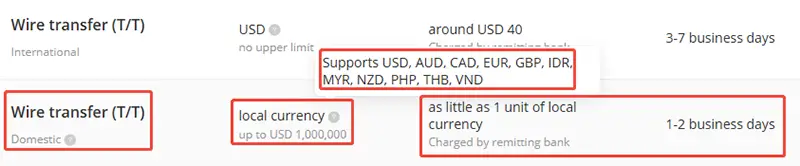
Wire transfer (T/T): Cost-effective for large orders, with flat processing fees.
Wire transfer (T/T):
- Widely used for large orders with flat bank fees, around $40–80, depending on intermediary banks.
- No upper limit.
- Processing time: 3–7 business days.
Domestic T/T offers lower fees and faster processing time than international T/T.
- As low as 1 unit of local currency
- 1–2 business days for processing.
However, domestic T/T is only available in certain regions:
- Mainly developed markets such as the US, Canada, Germany, the UK, and France.
- Some emerging markets, like Indonesia, Malaysia, and the Philippines.
Alibaba automatically prioritizes local payment channels when available. Transfer limit: up to USD 1 million per transaction.
Online Banking (local/regional)
1. Capped fees (percentage with a cap)
For example, in the US, online banking charges 2.99% with a cap at $30. This means:
- For orders above $1,000, the fee is capped at $30; online banking is more cost-effective.
- For orders less than $1,000, using card or PayPal payments is faster and safer.

2. Fixed fees (flat fee per transaction)
In many other regions, local online banking charges a fixed fee, typically $15 per transaction, regardless of order size. For example:
Trustly – Sweden, Denmark, Norway, Germany, the UK, and selected European countries.

- iDEAL – Netherlands

Additionally, Pix (Brazil), Pay-easy (Japan), and FPX (Malaysia) also typically charge fixed fees of $15 per transaction. Processing times vary—some are completed within 1–2 hours, while others take 1–2 business days.
For small orders under $500, percentage-based methods like credit cards can actually be cheaper than fixed fees.
Alibaba automatically shows available local payment options based on your location. If you see a fixed or capped fee, it is often one of the most cost-effective choices—especially for mid to large orders.
Note:
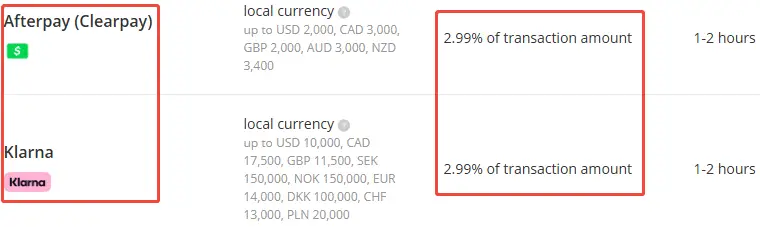
Buy Now, Pay Later (BNPL) options like Klarna or Afterpay are increasingly available in major markets like the US, Canada, and Europe, typically offering 3–4 interest-free installments.
For buyers, BNPL options usually come with similar processing fees to credit cards on Alibaba. They are suitable for small orders and come with amount limits.
L/C is available but rarely used. Due to higher banking fees, stricter procedures, and longer processing times, it is generally not cost-effective for most buyers.
How to negotiate payment terms with suppliers?
30% deposit to start production and 70% balance before shipping or against the bill of lading — this is the most widely accepted payment term.
In reality, whether you can negotiate depends largely on your order size.
If you’re placing small orders, there’s usually little room to negotiate. Most suppliers will stick to standard terms like 30/70.
Especially for orders in the range of a few hundred to around $1,000, your priority should be to find a reliable supplier willing to work with small orders. You should also arrange a quality inspection in China. This is how most experienced buyers manage risk when payment terms are fixed.
As your order value increases, or as you become a repeat buyer, suppliers are more willing to offer better payment terms—such as lower deposits or deferred payment terms like OA 30 days, meaning you pay 30 days after receiving the goods.
Also, for orders over $10k, buyers typically arrange a factory audit before placing the order to verify production capability and reliability.
Wrapping up
As a leading sourcing agent in China, JingSourcing has always committed to making product sourcing and customization simple, smooth, and safe—from finding reliable suppliers to delivering products to your door.
We regularly share practical insights on Alibaba and China sourcing—so you can avoid common pitfalls and make better decisions.
 Read More: